Bitstamp review: does the oldest licensed exchange still earn its fees under Robinhood?
Bitstamp has run since 2011 and now carries 52 licenses and registrations worldwide, more than almost any rival. We opened an account after the Robinhood acquisition to see whether roughly 110 coins and a 0.30% base fee still make sense next to bigger, cheaper platforms.
7.2out of 107.2
Our verdict
Bitstamp's licensing record, 52 registrations across the EU, UK, US and Singapore, is the strongest argument for using it, and Robinhood's June 2025 acquisition has not visibly weakened that. The catch is the fee sheet: 0.30% maker and 0.40% taker below $10,000 in monthly volume is expensive next to Kraken or Binance, and roughly 110 coins is thin next to exchanges that list 500 or more. Pick it for the license count, not the selection or the price.
Best for: Traders who prioritize regulatory coverage over coin selection or the cheapest fee
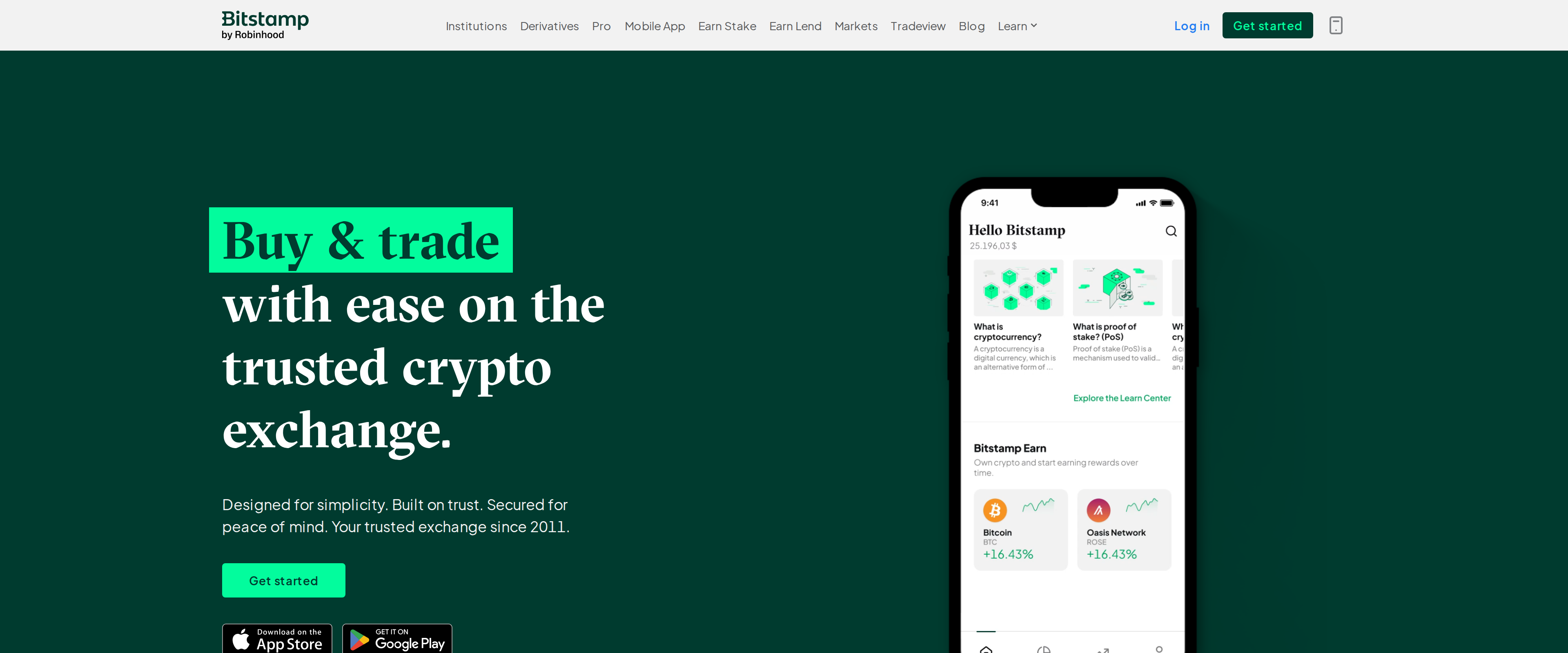
Bitstamp opened in 2011, three years before Coinbase turned into the company most people know today. It survived through a decade of exchanges that did not, and in June 2025 Robinhood bought it outright. We tested the exchange after that deal closed to see if the age and paperwork still buy anything.
The acquisition itself raised the obvious question: would Bitstamp start behaving like a Robinhood feature, stripped down and folded into the parent app, or keep operating as its own regulated entity. Months after the deal, our account still runs through Bitstamp's own platform, under Bitstamp's own licenses, with Robinhood listed as the owner rather than the operator.
The license count nobody else matches
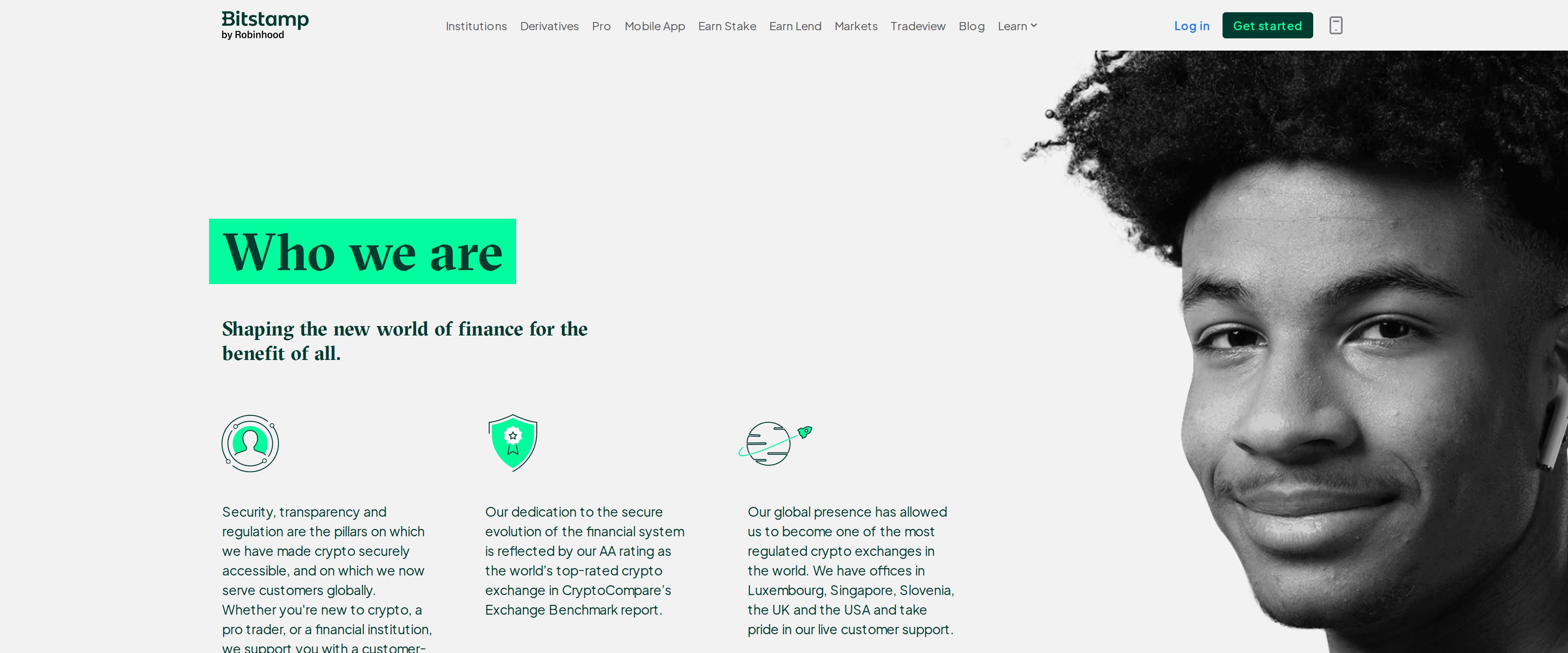
Bitstamp's about page leads with regulation, not price or speed
Bitstamp now holds 52 licenses and registrations across its operating entities in Luxembourg, the UK, the US, Singapore and the British Virgin Islands. The headline license is a MiCA Crypto Asset Service Provider authorization granted by Luxembourg's CSSF, covering the whole EEA under one regulator rather than a patchwork of national approvals. On the US side, Bitstamp USA holds a NYDFS BitLicense, one of the hardest state approvals to obtain. CryptoCompare rates the exchange AA, its top security and transparency tier.
None of that is marketing copy you can independently verify from a review desk, so we treat it the way we would treat any regulatory claim: real, checkable through public registers, and worth more than a badge on a homepage precisely because it is checkable.
What the fee sheet actually charges
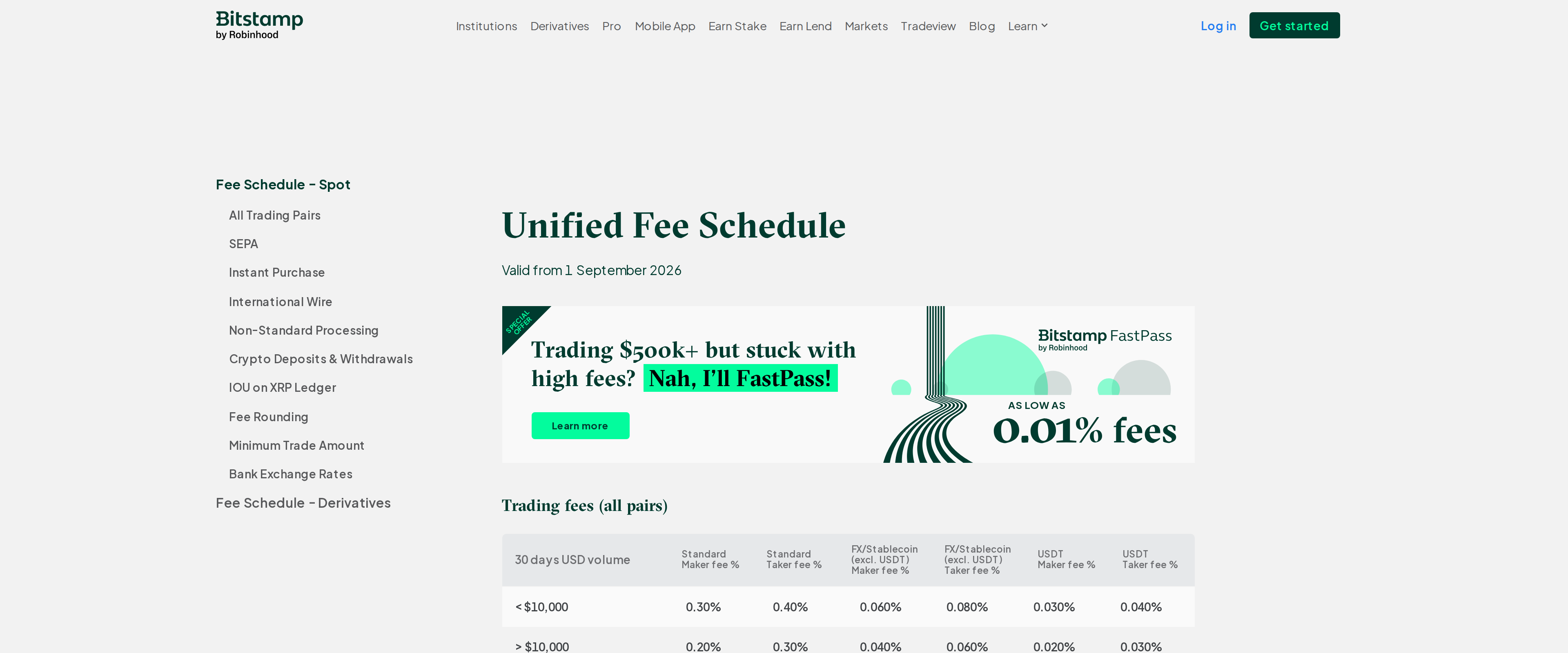
The published tier structure: 0.30/0.40% below $10,000 in monthly volume
Here is where the story gets less flattering. Below $10,000 in trailing 30-day volume, Bitstamp charges 0.30% to makers and 0.40% to takers. Cross $10,000 and the rate drops to 0.20% and 0.30%. Both numbers sit well above Kraken's comparable tiers and far above Binance's default 0.10%. Bitstamp's FastPass program advertises fees as low as 0.01%, but that tier targets accounts trading $500,000 or more a month, a bar almost no retail user clears.
A trader making occasional, moderate-size trades will pay noticeably more on Bitstamp than on a larger competitor for the exact same trade. That gap is the price of the license count above it, and whether it is worth paying depends entirely on how much you value that paperwork over the ten or twenty basis points. We ran a small BTC/USD buy and sell during testing and the round trip cost was noticeably higher than the same pair on Kraken the same week, purely on the fee schedule, with no difference in execution quality between the two.
A market list that stayed narrow on purpose
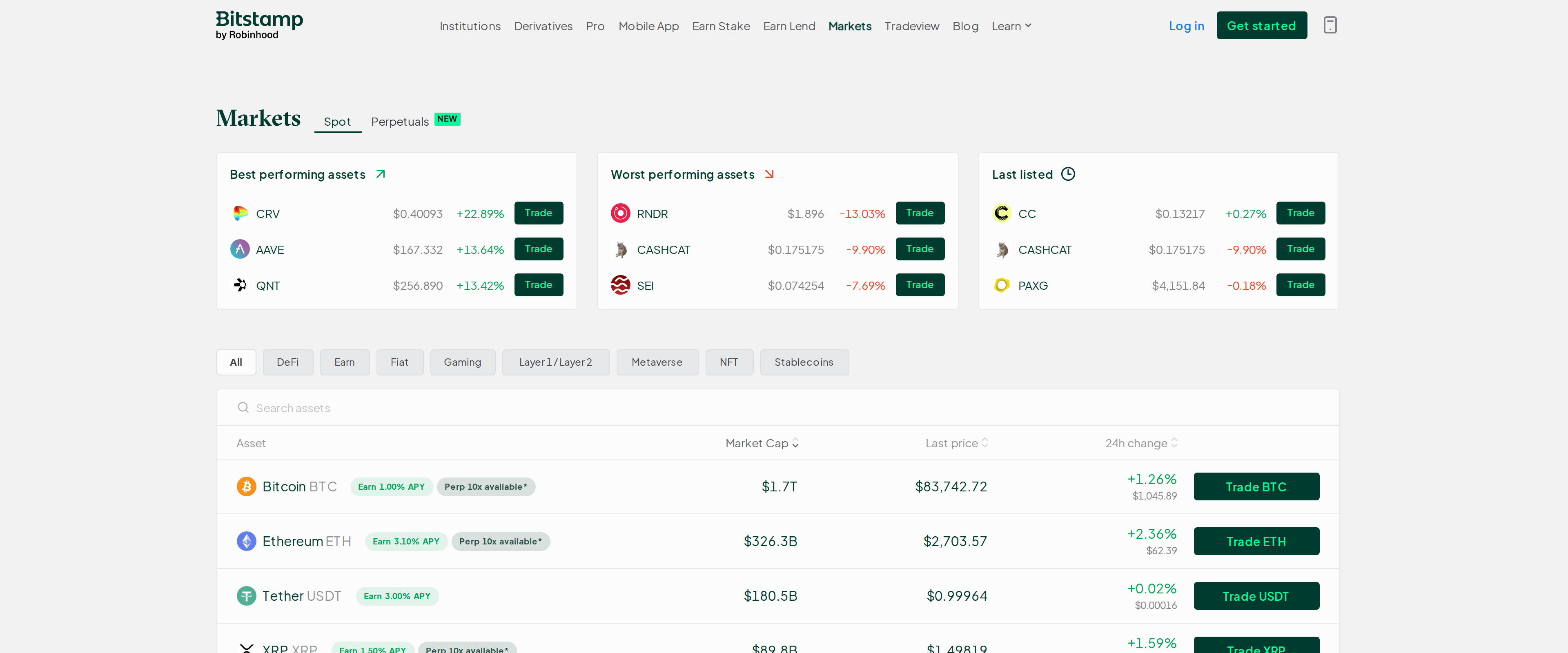
Live market data for BTC, ETH and USDT on the markets page
Bitstamp lists roughly 110 coins, a number that has not chased the fleet-wide race toward 500 or more listings that exchanges like KuCoin or Binance now run. Every asset goes through what Bitstamp calls a Digital Asset Listing Framework, an internal vetting process the exchange points to as the reason its list stays short. For a reader who wants exposure to Bitcoin, Ethereum, a handful of large-cap altcoins and major stablecoins, 110 coins covers the field completely. For a reader chasing a specific small-cap token, Bitstamp is very likely the wrong exchange before you even check the fee.
Earn products sit alongside the spot markets, with staking yields quoted directly on the coin's market row rather than buried in a separate section. That layout makes the passive-income option visible at the exact moment someone is deciding whether to buy, which is a small design choice but a deliberate one.
Verdict
Bitstamp earns its reputation the hard way: fourteen years of operation, 52 licenses, and an acquisition by a public company that did not visibly disrupt service. That reputation costs real money at the trade level, where base fees run two to four times what a larger rival charges below meaningful volume, and it comes with a coin list that will disappoint anyone shopping for altcoins. Choose Bitstamp if the license count and the AA security rating matter more to you than shaving fee basis points, particularly if you are trading from a jurisdiction where MiCA or a BitLicense-equivalent actually changes your legal footing. Skip it if you trade often or chase smaller tokens; the fee gap compounds fast, and the coin list will not catch up.
What we liked
52 licenses and registrations across the EU, UK, US and Singapore
MiCA CASP license through Luxembourg's CSSF covers the whole EEA
AA rating from CryptoCompare as a top-rated exchange for security and transparency
Operating without a major publicized breach since its 2011 launch
FastPass volume tier drops fees toward 0.01% for accounts trading $500k or more a month
What held it back
Base tier fees of 0.30% maker and 0.40% taker under $10,000 monthly volume are high
Around 110 coins listed, far short of exchanges that carry 500 or more
Fee tiers only turn competitive at volumes most retail users will never reach