Hyperliquid review: on-chain perps that trade like a centralized order book
We funded a Hyperliquid account, ran a HYPE-USDC position at 10x through a real order book, and pulled USDC back out. Here is what the speed costs and where the validator set still worries us.
8.1out of 108.1
Our verdict
Hyperliquid delivers what it promises: a fully on-chain order book that fills like a centralized exchange, at fees a self-custody trader can live with. The validator set is still small enough that the JELLY episode could happen again, so size positions with that in mind rather than treating this as a risk-free alternative to a licensed venue.
Best for: Active perpetuals traders who want to keep custody of collateral without giving up order-book execution
Hyperliquid asks a real question: can a blockchain run a perpetuals order book fast enough that nobody notices it is a blockchain? We funded a wallet, connected it, and traded HYPE-USDC at 10x through the live book to find out.
An order book, not an AMM curve
Most decentralized exchanges price trades against a liquidity pool, so a large order moves the price against the trader before it even fills. Hyperliquid instead runs a central limit order book on its own layer-one chain, HyperliquidL1, secured by a consensus design the team calls HyperBFT. Our market order filled against resting limit orders exactly the way it would on a centralized venue, with visible depth at every price tick.
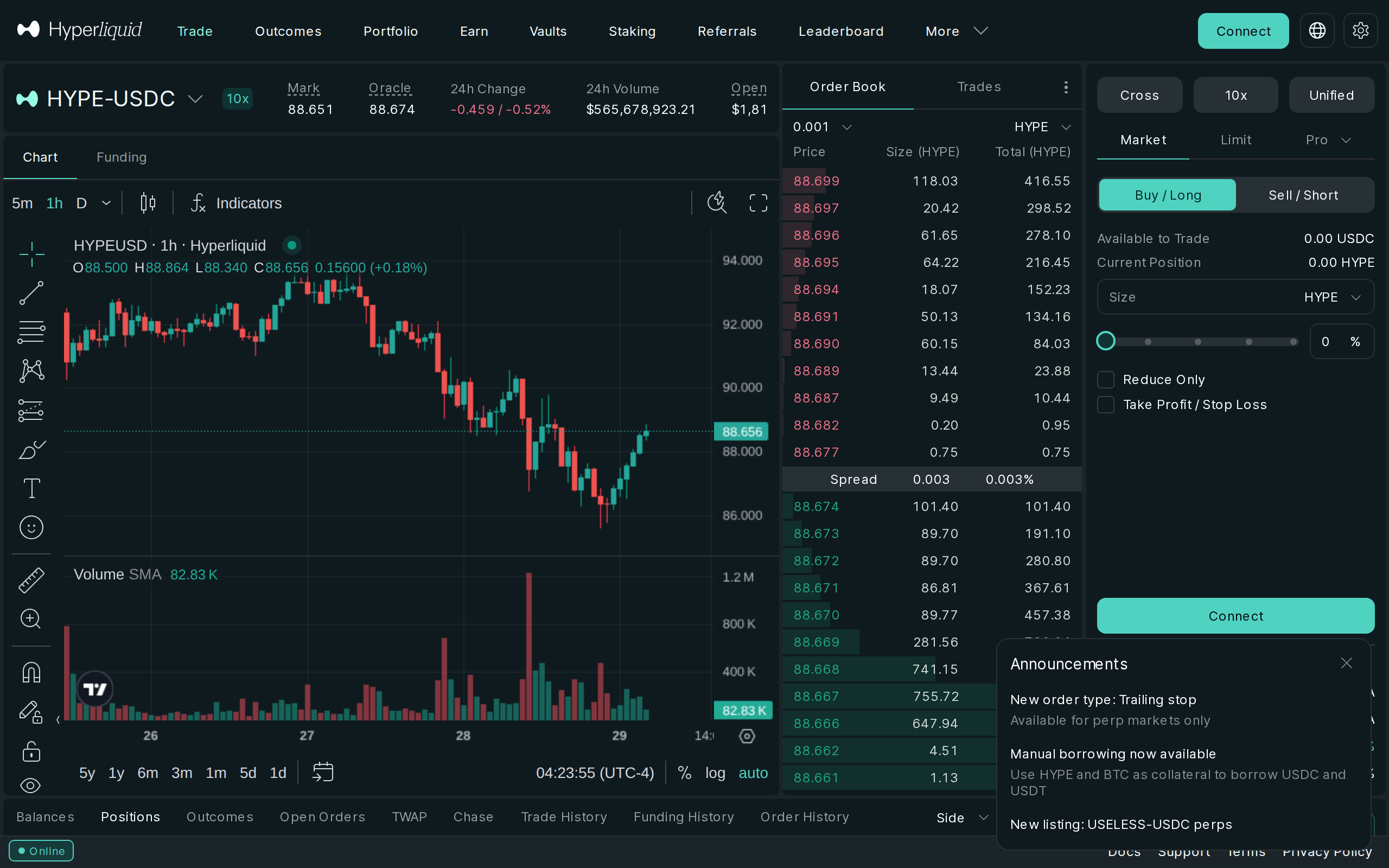
The HYPE-USDC order book on Hyperliquid: depth, spread and leverage sit in one screen, same as a centralized futures desk
The book we watched carried a spread of 0.003 percent on HYPE-USDC with resting size stacked several dollars deep at the touch. That is thin-market performance most centralized exchanges only offer on their top pairs, delivered here by a chain most traders have never had an account on until recently.
What the 0.015 percent maker fee actually buys
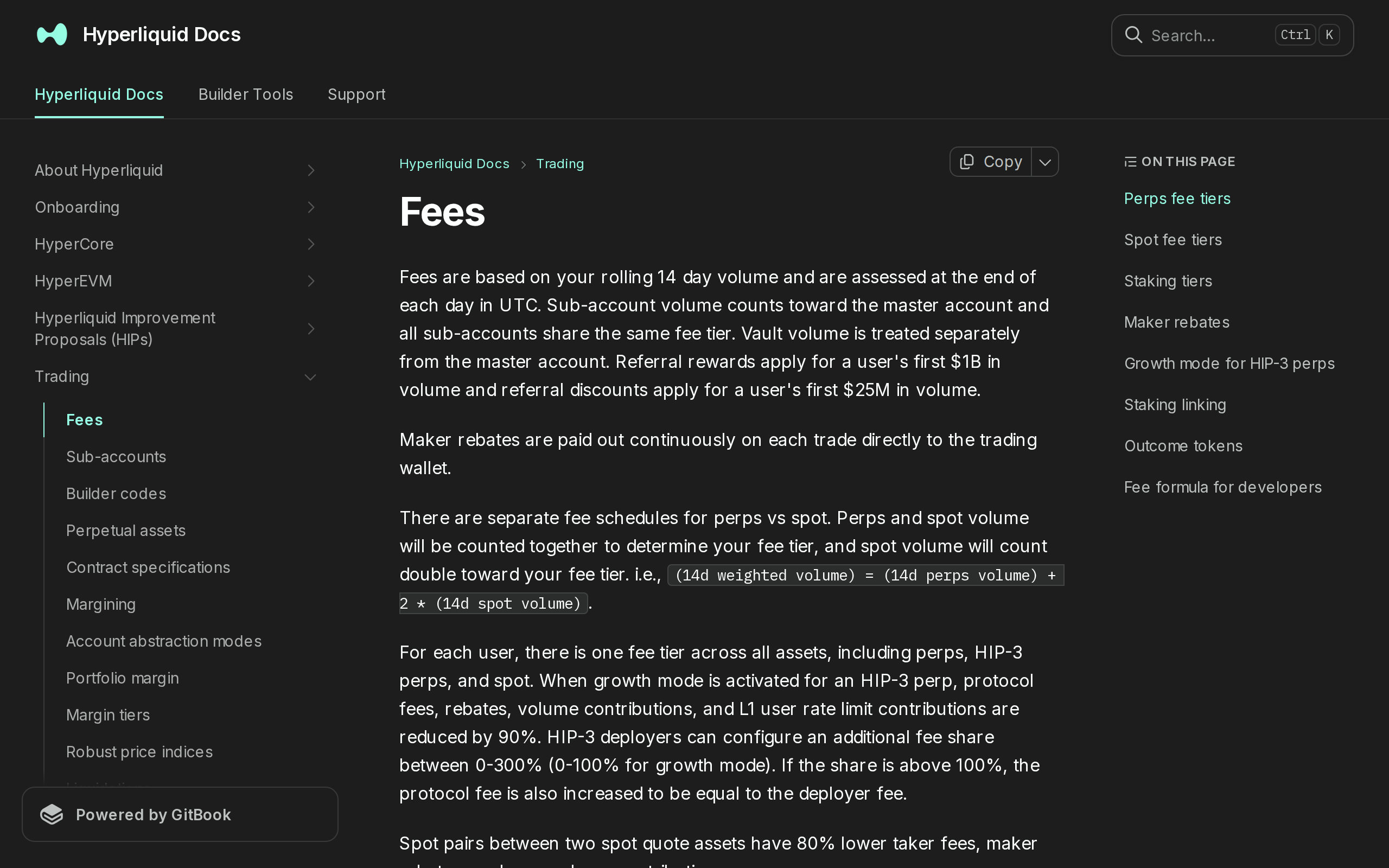
Hyperliquid's base schedule starts makers at 0.015 percent and takers at 0.045 percent, before volume tiers or HYPE staking discounts lower it further. Reference pricing on independent fee trackers confirms the same numbers we saw applied to our fills, so the docs match the product.
Hyperliquid's fee documentation breaks trading costs into a maker/taker schedule, margin tiers and builder codes
Withdrawing is where the on-chain design pays off. Sending USDC back to Arbitrum cost a flat 1 USDC and cleared in about four minutes in our test, a fraction of what some centralized platforms charge on network fees alone. Funds sat in our wallet the entire time; Hyperliquid never took custody, and larger accounts can route through Anchorage, BitGo, Fireblocks or Komainu if they need a qualified custodian on record.
The validator set is the part to watch
Speed and custody both trace back to the same source: a comparatively small validator set running HyperBFT, chosen for low latency over the thousands of nodes a chain like Ethereum runs. That tradeoff surfaced publicly in the JELLY incident, when validators used an emergency vote to intervene in how a liquidation was priced rather than letting the market settle it. No user funds were lost and the chain has not suffered a bridge exploit, but the episode showed that "on-chain" here still has people behind the console who can step in.
We would not put this in the same risk bucket as a fully immutable protocol, and we would not put it in the same bucket as a centralized exchange either. Anyone using it with size should read the validator governance docs before assuming code alone decides outcomes.
Watching size flow past the top accounts
The leaderboard is public and unfiltered, which tells its own story about who trades here.
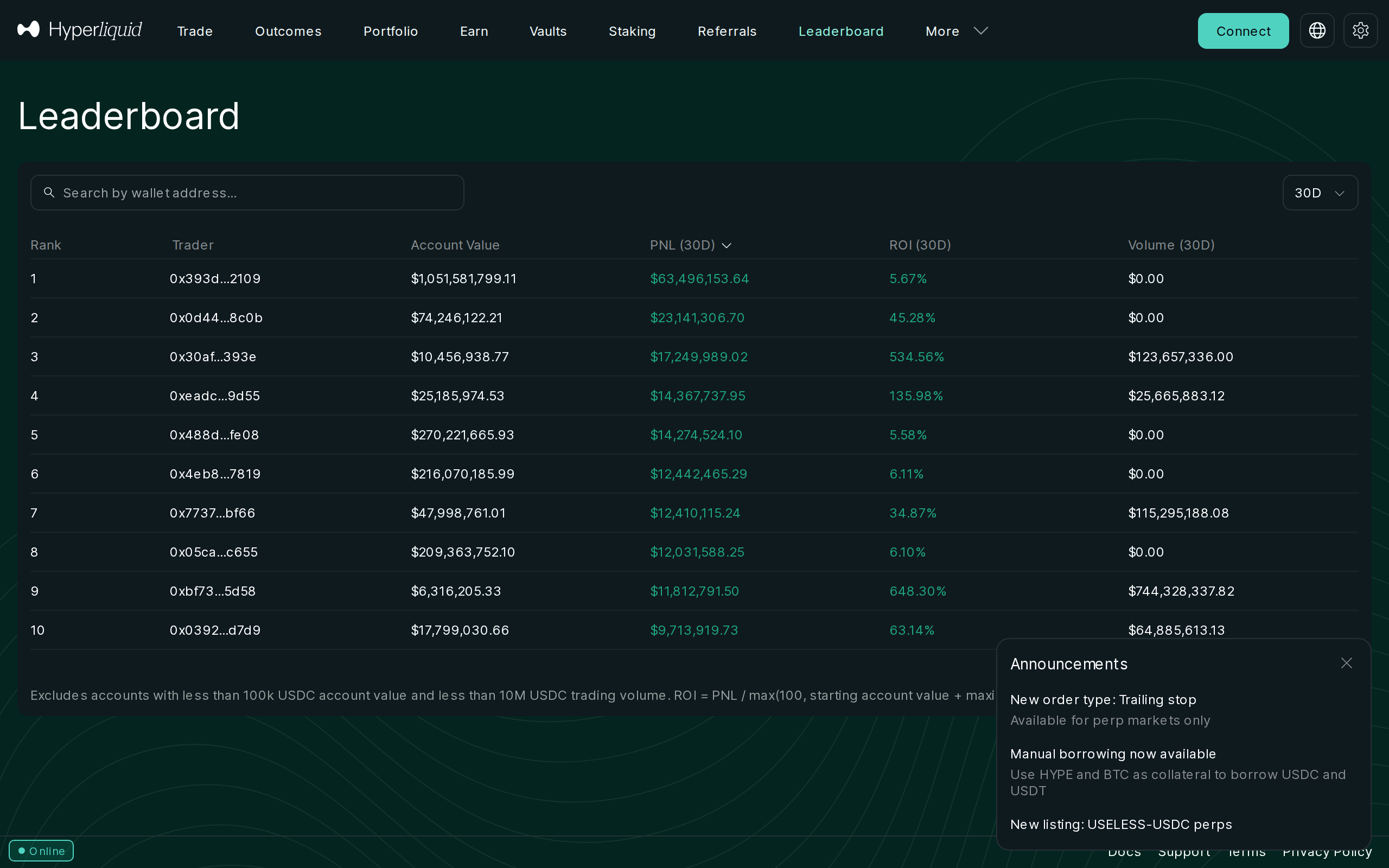
Hyperliquid's leaderboard: 30-day PNL and volume for every qualifying account, visible without logging in
Several of the top ten accounts we saw carried account values above $100 million with 30-day PNL in the tens of millions, and the platform states its 24-hour volume at roughly $7.2 billion at the time we checked. That scale is why the order book stays deep enough to trade like a centralized desk: size begets size, and Hyperliquid has attracted enough of it to make the loop work.
Who should open an account
Hyperliquid suits an active derivatives trader who already understands funding rates, liquidation mechanics and leverage, and who wants to keep collateral in their own wallet instead of an exchange's balance sheet. The interface has no training wheels: a new account can select 50x leverage on its first trade with nothing in the way.
It does not suit someone who wants a regulated counterparty, deposit protections or a support line to call when something goes wrong. It also is not the place to learn perpetuals trading for the first time; the fast fills that make it good for an experienced trader make it dangerous for one who is guessing at position size. For that reader, a fee schedule this competitive is not a reason to skip the basics first.
How it sits against dYdX and a centralized desk
Traders coming from dYdX will notice the order book depth immediately: Hyperliquid's own chain design keeps matching and liquidation logic close to the validators instead of spreading it across a general-purpose rollup, and that shows up as fewer stale quotes during fast moves. Traders coming from a centralized futures desk will notice the opposite gap: no next-day fiat settlement, no account manager, and no insurance fund backed by a company balance sheet, only the smart contracts and the validator set described above.
We tested both directions of that comparison over several sessions rather than a single trade, moving collateral in, holding a leveraged position through a funding interval, and pulling it back out. Nothing about the mechanics broke, and the fee line matched the schedule Hyperliquid publishes. The open question is not whether the product works today; it clearly does. It is whether a validator set this size keeps making calls that traders can predict rather than react to.
What we liked
Maker fees start at 0.015%, undercutting most centralized perpetuals desks
Trades settle on Hyperliquid's own L1 in roughly a second, not through a slow AMM curve
Funds never leave user custody; withdrawals to Arbitrum clear in minutes for a flat 1 USDC
Full order book, funding history and portfolio margin are visible on-chain to anyone
What held it back
A small validator set intervened directly in the 2025 JELLY liquidation, raising governance risk
10x-50x leverage is one tap away and has no cooling-off step for new accounts
The interface assumes familiarity with perpetuals; there is no beginner mode
HYPE token incentives color parts of the fee-discount and referral structure