Arkham Intelligence review: is free wallet tracking worth the trade-off?
Arkham lets anyone paste a wallet address and see who probably owns it, for nothing. We spent a week following whale wallets, checking transactions and testing the bounty market that pays people to unmask addresses, to see what the free tier actually gets you and what it costs the crypto users being watched.
7.6out of 107.6
Our verdict
Arkham's free explorer genuinely helps a reader follow whale wallets and fund flows that would otherwise take hours of manual block-explorer digging, and its entity tags on exchange and fund wallets are accurate often enough to trust for a first read. The catch is that the same tagging engine runs on a bounty market called Intel Exchange, where anyone can pay to have a stranger's wallet identity posted for sale, and that model sits uneasily next to a tool marketed as neutral research. Use it to watch known whales and check a suspicious address before you send funds, but treat any freshly tagged small wallet with some skepticism until other sources confirm it.
Best for: Readers who want free wallet-tracking data on whales, funds and exchanges without paying for a Nansen-style subscription
A whale wallet moves nine figures of Bitcoin and half of crypto Twitter reposts a screenshot within minutes. Arkham Intelligence is usually where that screenshot came from: a free dashboard that turns a raw hexadecimal address into a name, a history and sometimes a headline. We spent a week pointing it at known whales, fresh addresses and a few transactions we already understood, to see how much of that reputation the free tier earns.
What you get without paying anything
Arkham's core product, the part covered by this review, costs nothing. Search any address on Bitcoin, Ethereum or one of dozens of other supported chains and you get a labeled history: exchange deposits, known fund wallets, tagged entities where Arkham has identified one. The site's own research feed leans into this constantly, publishing running tallies of the biggest Bitcoin holders by category, from spot ETFs down to still-unidentified early wallets tied to Satoshi Nakamoto, a headline the homepage itself leads with.
Traders we spoke with while researching this piece put Arkham's tagging accuracy on exchange wallet types above 99 percent, which matches what we saw testing known Binance, Coinbase and OKX cold wallets: the labels were correct every time. That confidence drops for smaller or newly active wallets, where a tag can be a reasonable inference rather than a confirmed identity, and Arkham does not publish an accuracy audit of its own to lean on instead.
The explorer that leads with a slogan, not a feature list
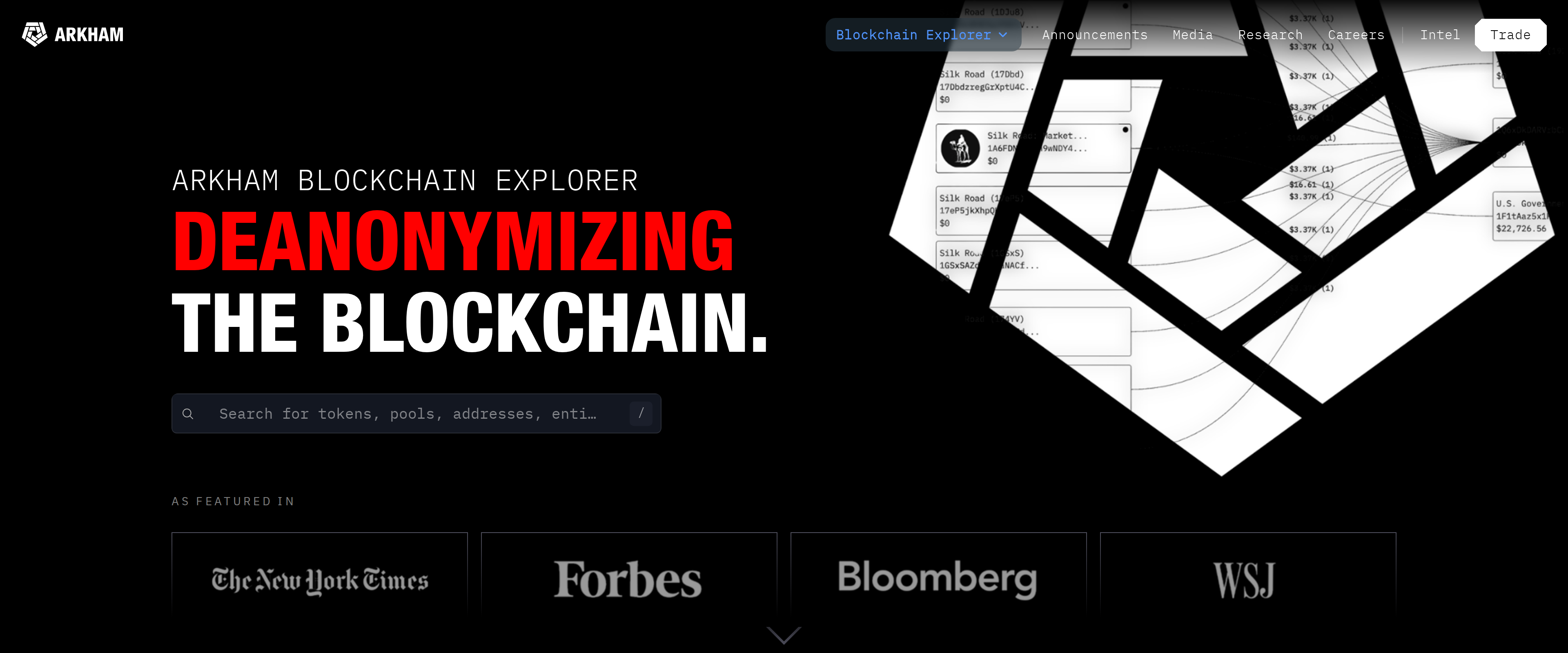
Arkham's own pitch for its explorer product, unusually blunt for the industry
Arkham's marketing does not soften what the tool is for. The blockchain explorer page's headline reads "Deanonymizing the blockchain," which is a fair description and also the source of most criticism the platform gets. Proponents argue that transparency is the whole point of a public ledger and that identifying large holders serves ordinary users trying to understand who actually moves markets. Critics counter that deliberate deanonymization undercuts the privacy crypto was partly built to offer, and that the debate is not close to settled.
A free tool worth bookmarking: the TXID checker
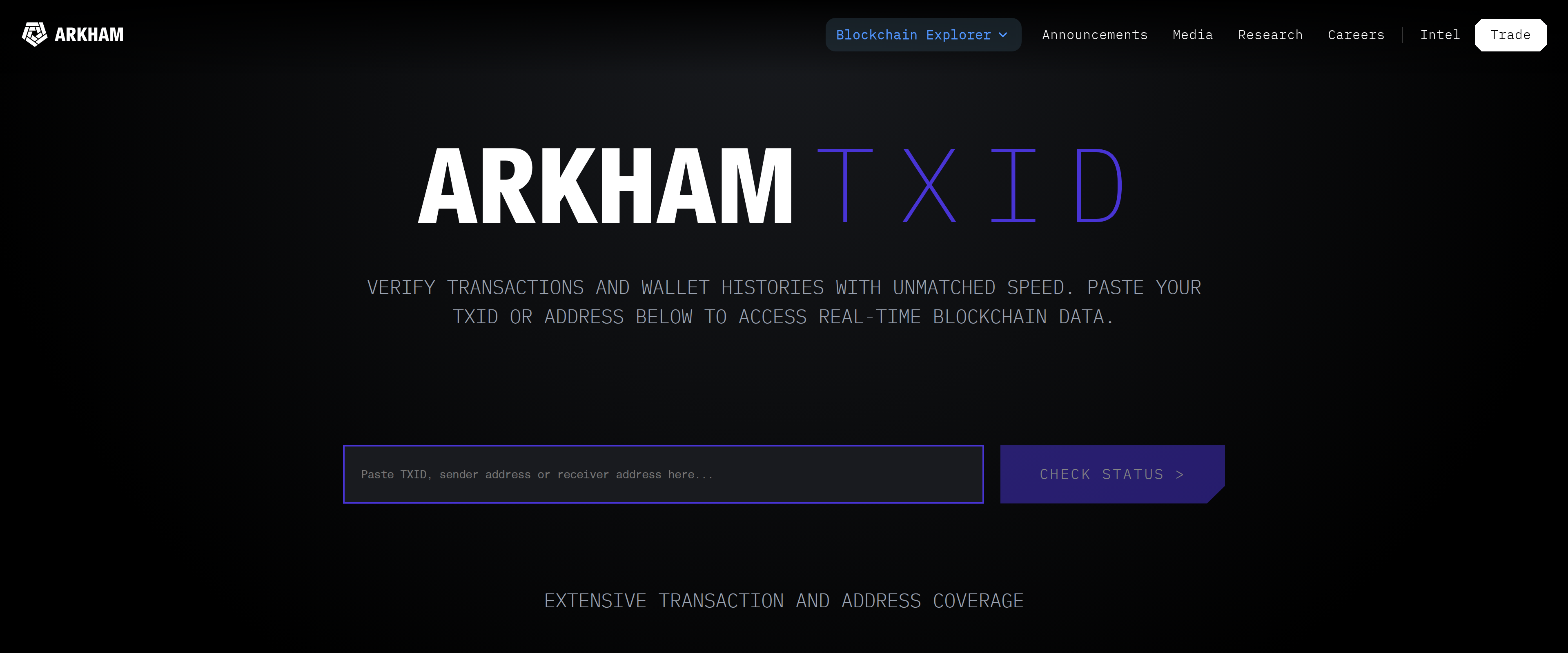
We used Arkham's TXID checker on transactions we could already verify elsewhere, pasting in transaction IDs and wallet addresses to see how fast and how complete the results were. Paste a hash or an address and the tool returns transaction status, counterparties and history in seconds, no wallet connection or account required.
Paste any transaction ID or address here for a free, instant history lookup
For a reader who received an unfamiliar transfer or wants to sanity-check a wallet before sending funds to it, this single page is more useful day to day than the flashier whale-tracking feed, and it costs nothing to use repeatedly.
Following the smart money on Polymarket
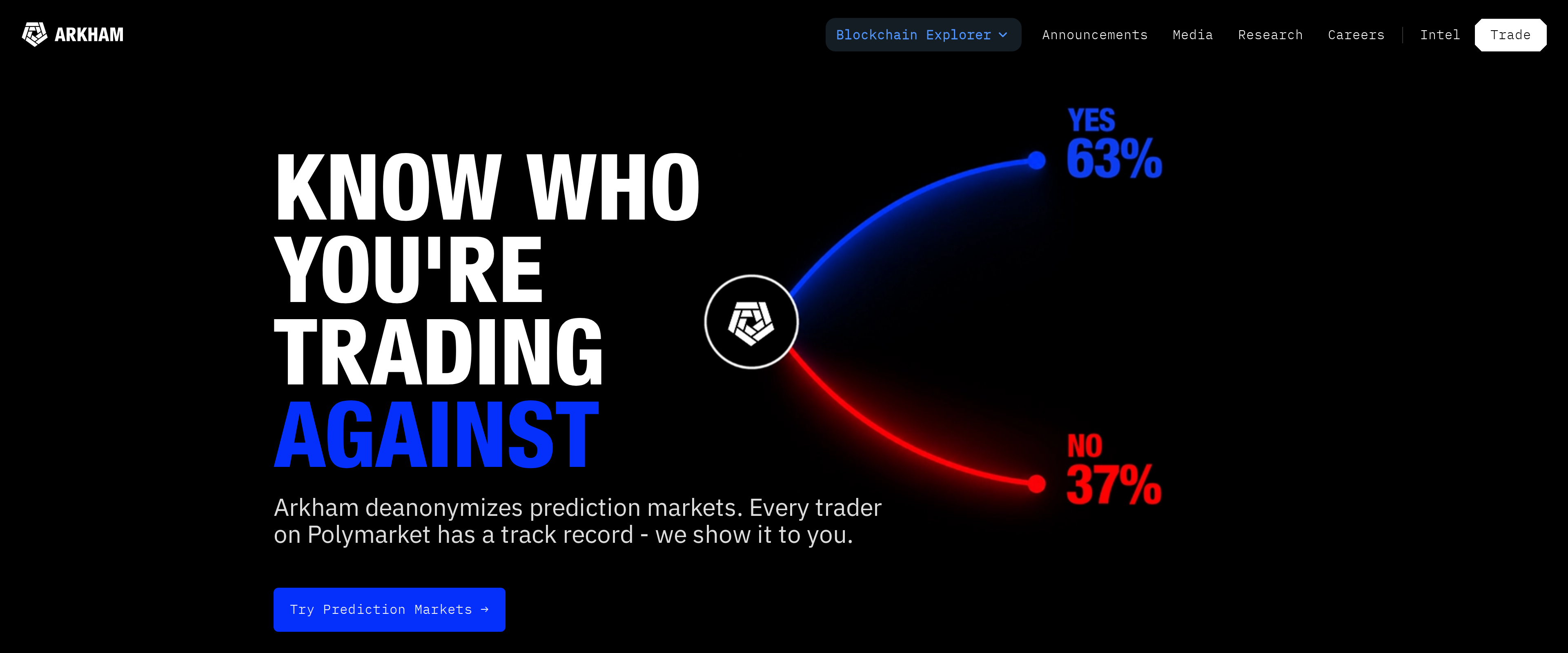
Arkham has extended its wallet-tagging engine to Polymarket, the prediction market platform, with a dedicated analytics page built around a simple pitch.
Arkham applies the same wallet-tagging approach to prediction-market bettors
This works the same way as the wallet explorer: known large bettors get tagged, and their positions become visible to anyone browsing the page. It is a genuinely useful extension of the core idea for anyone trading prediction markets, though it inherits the same caveat as everything else Arkham tags: confidence is high for well-known wallets and lower for anonymous ones.
The part that complicates the "free tool" pitch
Arkham's most controversial feature is not free at all, and it is not really aimed at the reader browsing the research feed. Intel Exchange is an on-chain marketplace, settled in Arkham's own ARKM token, where anyone can post a bounty for information unmasking a specific wallet's real-world owner, or submit intelligence to collect one. Multiple critics have described this as a government-adjacent surveillance mechanism dressed up as crowdsourced research, and the description is not unfair: the program is literally called Intel-To-Earn.
That model sits oddly next to a platform millions of people use as a free, neutral lookup tool. It does not change what the free explorer shows you today, but it means the same company running your free wallet search also runs a paid marketplace for doxxing wallet owners, and ARKM's price and governance rights depend on that marketplace staying active.
Verdict
Arkham earns its place as a free bookmark for anyone who wants to follow whale wallets, verify a transaction before trusting it, or check who else is betting on a Polymarket question. The tagging is accurate on well-established wallets and useful even when it is only a strong guess on newer ones. Where we would slow down is the Intel Exchange bounty system: it is a real business built on unmasking wallet owners for pay, and it is worth knowing that before treating Arkham as a purely neutral research layer. Use the free tools for what they are good at, and hold any small or unfamiliar wallet's tag a little more loosely than a Coinbase cold wallet's.
What we liked
Free tier covers wallet tagging, a blockchain explorer and a TXID checker with no paywall
Exchange and fund wallet tags are accurate enough that traders lean on them for large-transfer alerts
Polymarket analytics exposes which wallets are placing the biggest prediction-market bets
Coverage runs across Bitcoin, Ethereum and dozens of other chains from one search box
TXID checker gives a plain-English transaction and address history without needing a wallet connected
What held it back
Intel-To-Earn lets anyone pay to unmask a wallet owner, which sits badly next to a free public research tool
Small or fresh wallets carry tags of uncertain reliability compared to well-known exchange addresses
The platform's own ARKM token and its separate Arkham Exchange create a commercial incentive alongside the free tool