CoinGecko API review: when does the free Demo tier stop being enough?
CoinGecko's Demo API gives any project a free key with 10,000 calls a month and 18,000+ coins of coverage. We built a small price tracker against it, hit the rate ceiling on purpose, and worked out exactly where the $35 Basic and $129 Analyst plans start paying for themselves.
8.1out of 108.1
Our verdict
The free Demo key covers 18,000-plus coins and 1,500-plus exchanges at a stable 100 calls a minute, which is enough for a personal dashboard, a research script or a small Discord bot without paying anything. The ceiling shows up fast in anything with real users: a $35 Basic plan buys 300 requests a minute and 100,000 monthly credits, and a live product with more than a handful of concurrent users will need that within its first month. Start free, budget for Basic the moment your traffic stops being occasional.
Best for: Developers prototyping or running small tools who will upgrade once traffic is real
We built a small price tracker against CoinGecko's free Demo API to answer one question a lot of side projects ask eventually: when does free stop being free enough?
CoinGecko has run its aggregator since 2014, longer than most exchanges it now indexes, and the API grew out of that dataset rather than being built as a product on its own. That history shows up as depth: obscure tokens and small exchanges show up in the coin list well before they show up on a bigger platform's radar.
What the free key actually covers
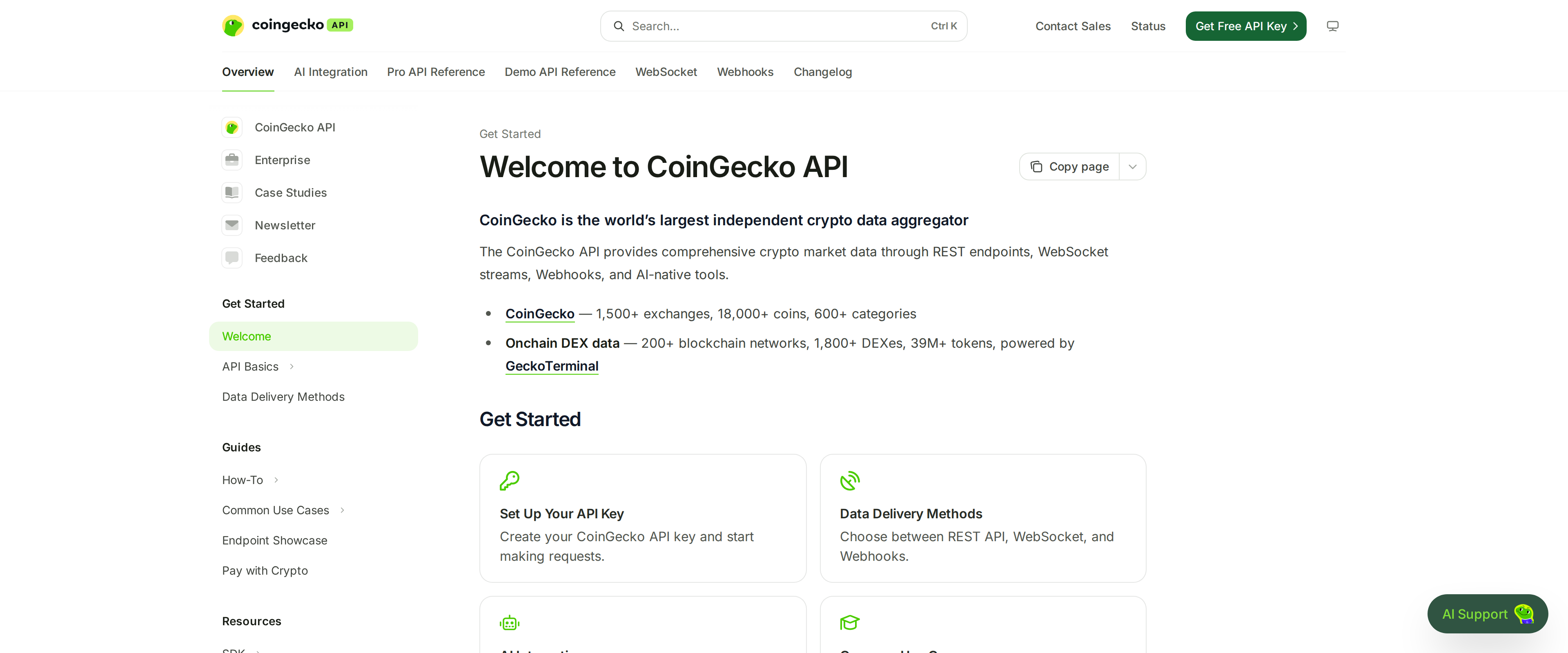
CoinGecko's documentation states coverage of more than 18,000 coins, over 1,500 exchanges and 600-plus categories, with a separate onchain layer covering 200-plus blockchain networks and 1,800-plus DEXes through GeckoTerminal data. That is a wide net for a product with no mandatory payment step: register an account, generate a key, and the coverage above is available immediately.
The rate limit that actually applies to you
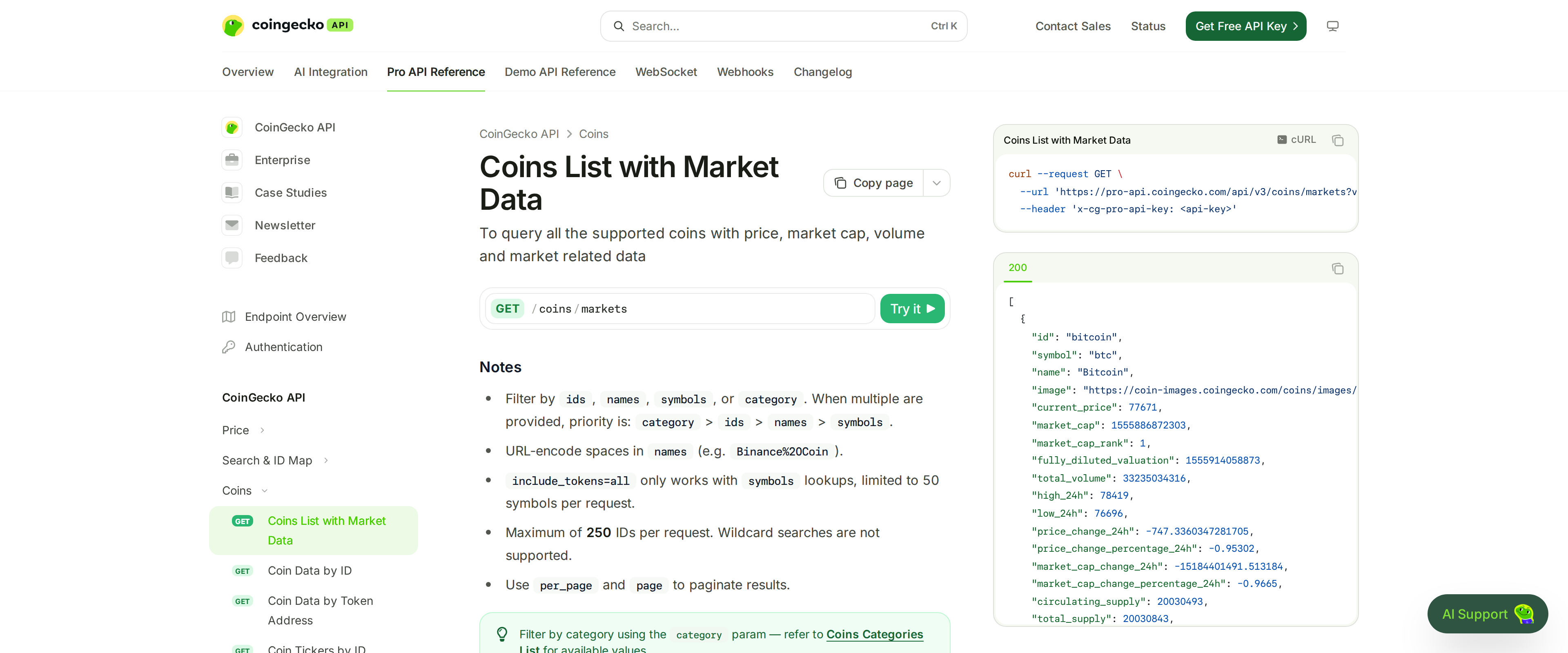
The endpoint reference lists every route, including the market data call we tested against
Here is the detail most comparisons skip: without a registered key, CoinGecko throttles requests to 5 to 15 calls a minute, shared across everyone on your IP address. That is unusable for anything beyond a curl command you run once. Registering a free Demo key changes the number to a stable 100 calls a minute, according to CoinGecko's own documentation, no credit card required.
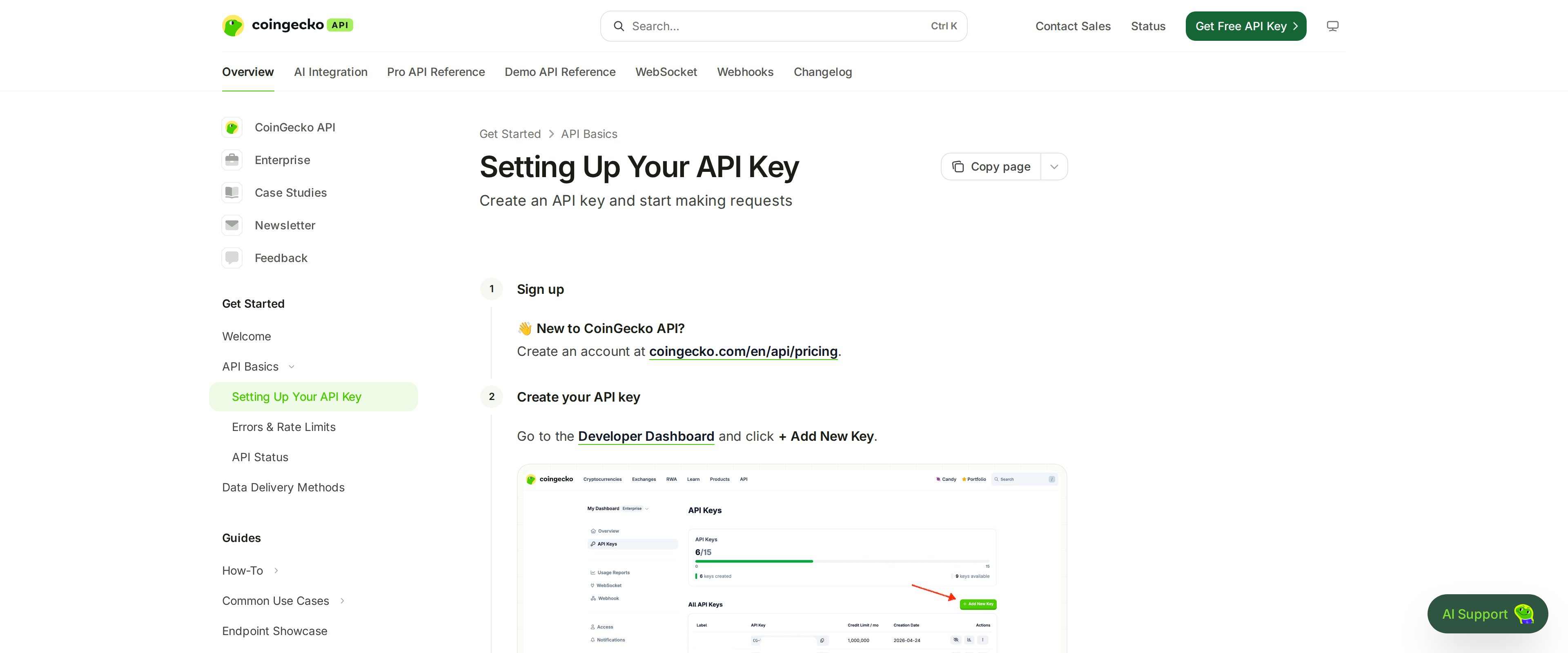
Setup takes one form: create a key, then start calling
We ran our tracker against the Demo key for a week, polling market data for 40 coins every five minutes. That workload stayed comfortably inside the 100 calls a minute ceiling and never triggered a 429. A bot pinging on every user message in a busy Discord server, or a dashboard refreshing for more than a handful of simultaneous visitors, will hit that ceiling within days.
We deliberately pushed past it once, firing 150 requests inside sixty seconds against a single Demo key. The first 100 returned normally, and everything after that came back as a 429 until the window reset, exactly as documented. Nothing broke on our end beyond the expected failed calls, which is the kind of predictable behavior a developer wants from a rate limiter.
Reading the error table before you need it
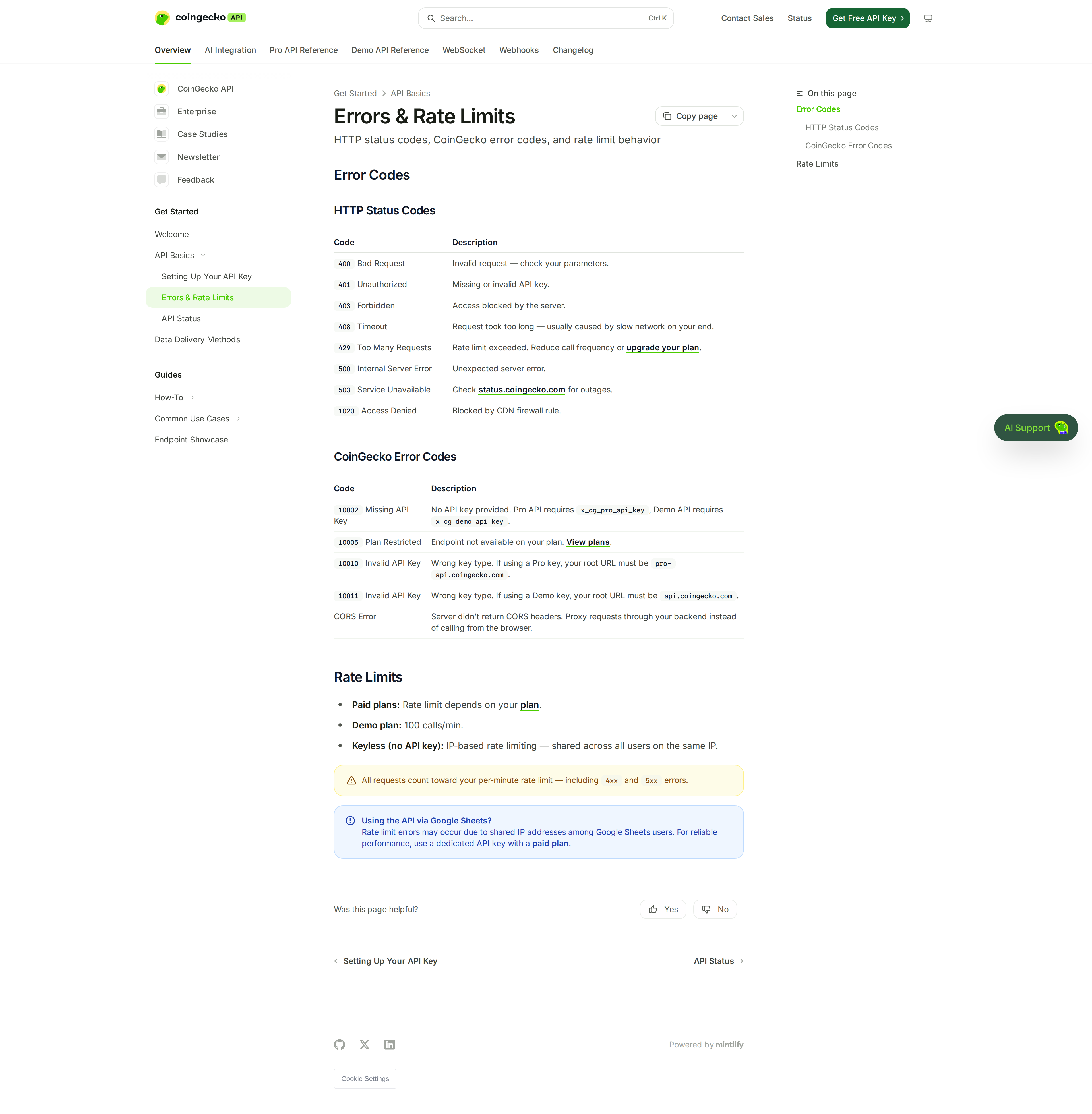
The current rate limit table: 100 calls/min on Demo, IP-shared when keyless
CoinGecko documents its failure modes plainly: a 429 means reduce your call frequency or upgrade, a 403 means the server blocked you outright, and code 1020 specifically flags a CDN firewall rule rather than a rate limit. All requests, including your own 4xx and 5xx errors, count against the per-minute ceiling, a detail that catches people who retry aggressively after a failed call and burn through their allowance faster because of it.
Where the paid tiers earn their price
The Basic plan at $35 a month raises the ceiling to 300 requests a minute and 100,000 monthly credits, a jump that suits a live app with a small but real user base. Analyst at $129 a month doubles the rate to 500 requests a minute and pushes the credit pool to 500,000, the tier most funded side projects land on once they stop being side projects. Lite jumps to $499 a month for 2,000,000 credits, a steep step up from Analyst that only makes sense once your traffic genuinely needs it rather than might someday need it.
Each tier also unlocks endpoints the lower ones simply refuse to serve, returning a plan-restricted error rather than a partial result. Check which specific endpoints your project calls before assuming a cheaper tier will cover it; the coin list endpoint we used stayed available everywhere, but historical range queries and some onchain routes sat behind the higher tiers in our testing.
Verdict
CoinGecko's free Demo tier is generous by the standard of market data APIs: real coverage, a workable rate limit once you bother to register a key, and documentation that tells you exactly how you will fail before you fail that way. It is not a tier you build a funded product on. The moment your project has real concurrent users rather than a handful of testers, the $35 Basic plan is not a luxury, it is the difference between a working feature and a wall of 429 errors. Start on Demo, watch your call volume for a week, and upgrade the day the number stops being comfortable.